Saturday, April 4, 2015

Mining

Part A:

1) What is strip mining? How is it done? Pros/cons?

Strip mining is removal of soil and rock above a layer or seam (eg. coal), followed by the removal of the exposed mineral.

First, the trees and bushes are pushed down with bulldozers. All of this, along with the filth or sand under it, is taken to a close area and dumped. Lots of holes are drilled from the rock that is above the coal or mineral bed. Explosives are put in the holes and blazed. This breaks up the rock which is taken to the dumping area.
When the coal or mineral is found, it may be broken up by the blazing. The size of the chunks is important because the miners don’t want it in pieces. They usually want it in pieces that are capable to be moved with big machinery.
This mining is done in elongated, narrow strips. When the ore is done in one strip, the miners start to create another strip next to it. The waste, filth, and rock that they take off of the top of the next strip is put on top of the last one. This is recurring until the last strip is done and the waste from the primary strip is brought back to fill it.

Image result for strip mining

Pros -
  • Low cost method of recovering minerals (if the strip ratio and other parameters are good).
  • Safer if conducted in the properly, much safer than underground coal mining. 
  • Can reshape topography of the earth to improve drainage, give more flat land.
Cons -
  • Negative impact on wildlife.
  • Reduce agriculture productivity.
  • Explosives can cause vibrations and affect nearby structured and buildings.


2)What is shaft mining? How is it done? Pros/cons?

Shaft mining is the method of excavating a vertical or near-vertical tunnel from the top down, where there is initially no access to the bottom. This method is used when the rock or mineral is so far to reach using strip mining.

The shaft mine has a perpendicular man shaft, a tunnel where the men move up and down in an elevator. Equipment is taken deep inside the mine using this shaft, too. Short tunnels to the ore are excavated from that man shaft. When the ore is dynamited and broken into chunks, it is taken to the apex and loaded into trucks via a second shaft. There is normally an airshaft that gives the mine ventilation.
Tunnels are deepen and the mine is made bigger until there isn't any ore left, or it costs so much money to get it out. The mines are filled with some kind of cement or filler when mining is done. This keeps the land round it from sinking when the in mine beams rot away. It is a safer way to close a mine.
 
Image result for shaft mining
 
 
Pros -
  • Uses less land area compared to strip mining.
  • Easier to close mine than strip mining.
  • Does not affect agriculture productivity.
Cons -
  • Not a safe method, miners can get stuck in the shaft.
  • Threats of cave-ins and release of toxic gases.
  • Slower rate at extraction because space is not open like strip mining.
Part B:
 
1) Spouse of a miner

I would chose strip mining because it is a much safer method. Work safety would be a big priority for my spouse.
 
2) Owner of a mining company
 
As the owner of a mining company, I would chose strip mining since it is the most efficient method. There is no space restrictions, only open surface so the rate of extraction is faster. With the open field, it is easier to also survey any safety hazards. Because this method is so efficient, it is low cost.
 
3) Environmentalist

I would not chose any mining to be done at all. Mining in general has negative impacts on the environment as vegetation, wildlife, and air quality are all affected.
 
4) Owner of a nearby ski resort

I would chose shaft mining because the explosive of strip mining might release vibrations which might affect the ski resort. In strip mning, vegetation is not stabilized on the surface and so landslides and rockslides can occur without warning which would be a safety hazard for people at the ski resort.
 
5) Politician
 
 I would chose strip mining as it has less human casualities. Work safety is important and safety hazard is can be easily surveyed with the strip mining method.


Part C:

1) What does Turkey mine for? What type of mining is common?

Turkey mines for coal and other minerals. Shaft mining is also a common method used. In Turkey, especially in Anatolia, mineral exploration and mining facilities of deposits for metals and raw materials dates back to ancient times. Turkey has the largest prospective land area in Europe. However, the complex geologic structure of Turkey makes it more difficult for mine exploration and mining facilities. Turkey is one of the few countries which can provide most of their raw materials.
 

TRAVEL TO TREMENDOUS TERRIFIC TURKEY (that alliteration though)


(wow nice grass)

Where else in the world is it located? 

Turkey is a temperate grassland biome.


Other parts of the world that have the same biome as Turkey are countries such as China and the plains and prairies of North America. 


Climate (Precipitation/Temperature characteristics)

Precipitation is less in temperate grasslands. Average precipitation ranges from 20-35 inches per year.Temperatures vary according to the season. In winter, temperatures can go to -17 degrees Celsius in some areas. In summer, temperatures can go to 32 degrees Celsius.


Animals found in the biome


Animals vary in temperate grasslands. It can include bison, gazelles, zebras, rhinoceroses, and wild horses, lions, and wolves. Other animals are: deer, prairie dogs, mice, jack rabbits, skunks, coyotes, snakes, foxes, owls, badgers, blackbirds, grasshoppers, meadowlarks, sparrows, quails, and hawks. 


(bye son)

Plants found in the biome (Vegetation type)

Since there is less precipitation in temperate grasslands, very tall trees would be hard to spot. Although, grasses  have adapted to cold temperatures and drought so they have deep, massive root systems that take hold in the soil. This allows the grasses to remain firmly rooted in the ground to reduce erosion and to conserve water. Some examples of vegetation include buffalo grass, cacti, sagebrush, perennial grasses, sunflowers, wild indigos, and clovers. 


(so much grass)

 How have animals adapted to live within this biome?


Some animals have certain features that help them survive in this biome. A Ungulates, which is a mammal that has hoofs just like horses and deer. Their long legs helps them escape from predators in the temperate grassland. Ungulates are also plant-eating mammals and the temperate grassland is a perfect source of food for them as temperate grasslands contain an abundance of grass. The dominant animals in temperate grasslands are herbivorous or plant-eaters. Due to the lack of trees and open space in temperate grasslands, many temperate grassland animals have front legs and paws that are adapted to dig burrows where they can be safe from predators.


a
(yaaasss hoofs)


How have plants adapted to live within this biome?

There are many species of grasses that occupy temperate grasslands which include purple needlegrass, wild oats, foxtail, ryegrass, and buffalo grass. Many animals have grass as their main food source but grass survives because the growth point of the grass is close to the ground and are not easily destroyed by fire compared to shrubs and trees because grass have underground stems and buds.


What is the soil type associated with the biome?

The type of soil associated with temperate grasslands are chernozem. Chernozem is a fertile black soil rich in humus that contains a lighter lime-rich layer beneath.

Image result for chernozem in temperate grassland


What are some Limiting Factors?

Grass fires are a limiting factor because they can deplte food source for many animals that live in a temprate grassland. Another factor is the grazing of livestock which can cause disruption of the grasslands and allow the spreading of cacti and invasive plant species.

Image result for grazing of livestock


What are the Human Impacts on this biome?

Many animals have been hunted for their value such as bison, which results in the near extinction of these animals. Due to the burning of fossil fuels by humans, wildfires can occur on the grass which will damage the soil. Humans also use temperate grasslands for agriculture which can cause soil erosion.

Image result for grass wildfires
(wildfire bad)


Bibliography

Bailey, Regina. "Temperate Grasslands (Climate, Vegetation, Animals)." About Education. NA, na. Web. 04 Apr. 2015.

Carr, Kevin. "What Are the Impacts of Humans on Grassland Biomes? | The Classroom | Synonym." The Classroom. NA, na. Web. 04 Apr. 2015.

NA, NA. "KDE Santa Barbara." KDE Santa Barbara. NA, 2004. Web. 04 Apr. 2015.

NA, NA. "Temperate Grasslands Biome." Temperate Grasslands Biome. NA, 2003. Web. 04 Apr. 2015.


Monday, March 23, 2015

Waste Management

1) What are some ways Turkey disposes of waste?

• Sanitary Landfill

Waste materials stored by depositing and compacting in large areas that have an impermeable layer to prevent soil and air matter pollution. The layer is formed of compacted clay. Most vital thing is to prevent any harmful effects on tbe environment. 

• Incineration

Only used for medical waste. 

• Sterilization

Sterilization plants have been constructed to sterilize the garbage making it clean and then compacting it to be of use for soil. Currently, the method used for sterilization is immersion by liming. Liming is when you treat soil or water with lime to reduce acidity and improve fertility or oxygen levels. Immersing waste materials in liming will help reduce harmful effects. 

• Composting 

Important for the use of fertilizer for agriculture.

• Advanced Disposal Methods

This method consists of pyrolysis (decomposition by high temperatures), gasification, plasma, etc. Not used wide-scale in Turkey. 


2) What are some challenges Turkey will face in terms of waste disposal? 

• Population 

The population of Turkey continues to increase and so it results to larger amounts of waste materials which would affect the environment and human health. Turkey needs to find ways to control their waste disposal efficiently as it will become a difficult matter. 


3) Ways that Turkey can improve on their waste management strategies. 

• Recycle

Recycling will help reduce waste materials. Recycling will reuse waste materials and turn it into good use such as turning it into clothing. 

• Reduce

Reduce on using things such as plastic bags for grocery shopping. 

• Reuse

It is important to reuse so resources do not go to waste. For example, if you are using paper use both sides. Use reusable shopping bags and try to buy products in returnable bottles. 

• Enforce recycling and composting

Make sure that there are recycling and composting bins available for people. People need to be educated on what waste materials can actually be reused again.


Wednesday, March 18, 2015

Impact of Climate Change

  1. Lithosphere

    Soil degradation is an example of climate change that has had an impact on the lithosphere. Turkey has had a decrease in winter precipitation, which has resulted in a degradation of the soil moisture content and a depletion of the ground water level over most of the country. These dry winters and humid conditions will result to an increase of climatic changes towards soil degradation such as in the Mediterranean and Aegean regions of Turkey as shown below in the picture. 

  2. Hydrosphere

    Saltwater intrusion has affected countries along the Adriatic and the Mediterranean sea. Because of the rise of sea water levels, there is saltwater intrusion. 


    Saltwater intrusion into aquifers have affected the Turkish coasts. It is one of the key potential effects of sea level rise in cities such as Istanbul.


    The Turkish coasts affect the fresh drinking water of people who live in the country. It also affects the crops and vegetation needed to grow for food. Without fresh water and the continuous rise of sea levels, Turkey might be left with no source of fresh water to drink and grow food, and possibly great floods that will destroy the city.


  3. Biosphere

    One of Turkey's major crops, wheat fields, are being destroyed because of climate change. With the increase of temperature and lack of precipitation, these wheat fields don't grow. With damages on Turkey's major crops, food for the people will become a problem and economic trade with other countries will have a negative impact. Living things such as humans and animals, will be greatly affected.

    Image result for wheat fields in turkey
  4. Atmosphere
    Turkey has experienced a great change in air temperature due to climate change. Annual temperature over the period 1961–1990 showed a trend of statistically significant warming over land in south-east Europe of approximately 0.4–0.6°C per decade. The trend for Turkey is relatively large over summer at 0.34°C per decade. The trend for Turkey in winter is very small at -0.01°C per decade. If the trend continues and it gets warmer, crops would not grow with too much heat and people could be affected with heat stroke.

    Image result for heat changes in turkey

Monday, March 2, 2015

Tornado in Turkey

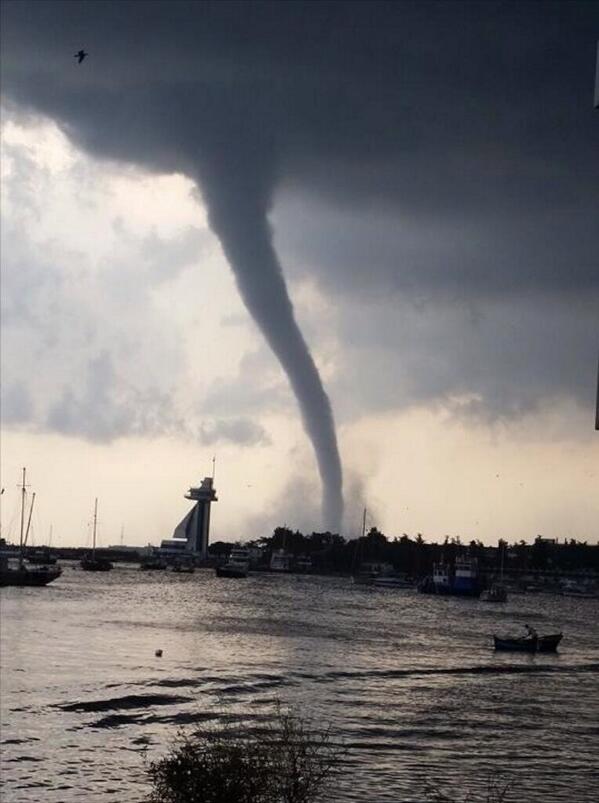
During the summer of 2014, a twister tornado had hit parts of Istanbul. The tornado passed over the Marmara Sea before hitting the Pendik and Tuzla neighborhoods in the east of Turkey’s biggest city and port. It continued its journey to the Kozaeli province.

View image on Twitter

Tornados happen occasionally in southern Turkey, but rarely in Istanbul in the north of the country. The tornado was the latest extreme weather incident to hit Istanbul, which had an unusually dry spring followed by heavy rain.


Turkey's Istanbul hit by rare tornado

The rains caused extensive local flooding. Fences and roofs were damaged and several windows were broken, shattering glass around the area. The tornado had resulted to economic impacts as money was needed to be spent to rebuild buildings and houses for people who were affected from the tornado. Any infrastructure or roads destroyed also needed to be fixed. The environment had an impact because of the devastation that was ruined by the tornado; plants, crops, and trees were destroyed.
 

Sunday, February 22, 2015

5 Themes

1) Location - Absolute/Relative

There are two different types of location which is absolute and relative. For absolute location, it is talking about your exact location, your exact coordinates in where you are and it always differs. For example, if you were to visit the Museum of Anatolian Civilizations in Ankara, Turkey, your absolute location (in coordinates) would be 39.9383° N, 32.8619° E.

Image result for absolute location of museum of anatolian civilizations ankara turkey

Relative location differs from absolute location because it is not about the exact location. Relative location is the distance from one place to another. For example, the distance from Ankara, Turkey to Surrey, BC is 9,818 km.


2) Place - Human/Physical Characteristics

Human characteristics is when humans have changed and made an impact in a place. For example, in Ankara, Turkey, they have built the Kocatepe Mosque which is the largest and most notable mosque in the city. If humans have not inhabited Earth or Turkey for instance, the mosque would not have existed.

Kocatepe Mosque, Ankara

Physical characteristics are natural features in a place. Humans have no part in the making of natural features because nature or other elements are the ones that make the feature. For example, Turkey has many mountains such as the Taurus Mountains that are located across southern Turkey and the Anatolian Plateau.

Image result for taurus mountains turkey


3) Movement

Movement is an act of changing physical location. In the city of Ankara, Turkey, there are many ways to get around the city using public transportation. For example, people can go on the Kecioren ropeway which connects to the subway stations.

Ankara Sentepe ropeway

People can also go on the subway station that runs throughout the city.


4) Human-Environment Interaction - Adapt/Depend/Modify

In Turkey, the climate is very hot and dry during the summer and rainfall occurs often in the spring and autumn. With this, they adapt to the weather by wearing lighter clothing and having cooling systems in their houses. Because of their location, Turkey can face possible earthquakes so they adapt to that by building earthquake proof buildings and infrastructure and preparing for supplies that are needed.

Image result for ankara turkey hot weather

Due to the hot climate, Turkey depends on certain things to survive. They depend on water for drinking and growing food and trees such as the Northern Anatolian conifer and deciduous forests which covers most of northern Turkey for trade.

Image result for The Northern Anatolian conifer and deciduous forests in northern Turkey
Turkey has modified its country by cutting down forests to create cities which include houses for people and buildings for services for people, which also provides jobs. The land has been cleared to make roads, farmland, and landscapes.

Image result for ankara Turkey city


5) Region

Turkey has many regions which are the different areas in the country. It includes Central Anatolia and the Marmara region. All of these regions have their own characteristics that differ from each other.

Image result for central anatolia turkey map